
Purpose-Built Hardware for Rapid Emergency Response
When a “bad day” actually hits, a box of cartoon bandages and a safety pin won’t cut it. For decades, the mainstream first aid market has pushed clunky, slow-to-access plastic tackle boxes masquerading as first aid kits. But in a real emergency, you don’t need an unorganized bin of minor conveniences. You need an engineered system built for survival.
Individual First Aid Kits (IFAKs) have completely rewritten the rules of emergency readiness. Compact, ruthlessly organized, and built for rapid, stress-induced deployment, a proper IFAK is designed specifically to treat life-threatening trauma before professional help arrives.
At Guerrilla Tactical, we approach trauma gear with the same technical focus we bring to our holster engineering—because every millimeter of your loadout must serve a life-saving purpose. Guided by the philosophy that we are our own first responders, we curate high-performance IFAK solutions to ensure regular people have the exact tools needed to act as immediate responders for their families and communities.
Whether you’re setting up your very first tactical trauma kit, upgrading your vehicle loadout, or figuring out exactly why a dedicated trauma kit completely demolishes a legacy first aid kit, let’s break down the “what and why” of modern IFAK architecture.
1. Tactical Architecture: The MARCH Protocol vs. The Junk Drawer
Traditional first aid kits are reactive. They are designed for minor annoyances—scrapes, blisters, and small kitchen burns—and they feature a passive, loose layout that forces you to dump the entire kit on the ground just to find what you need.
A true IFAK is an active, feature-rich life-saving tool organized around the MARCH protocol. MARCH is the gold standard of tactical trauma care, providing a hard, step-by-step framework to manage critical injuries when your adrenaline is spiking and fine motor skills go out the window:
- M (Massive Hemorrhage): Severe bleeding is the single leading preventable cause of death in trauma scenarios. IFAKs put arterial occlusion tools—like the Combat Application Tourniquet (C-A-T)—right at your fingertips for immediate deployment.
- A (Airway): Rapidly securing a patent airway to prevent suffocation.
- R (Respirations): Sealing open, sucking chest wounds with specialized chest seals to stop a tension pneumothorax in its tracks.
- C (Circulation): Assessing pulses and stopping secondary bleeding with high-performance hemostatic agents and packing gauze.
- H (Hypothermia/Head Injury): Preventing the lethal triad of trauma by maintaining core body temperature using thermal blankets.
By structuring a kit around this exact hierarchy, you eliminate the guesswork when seconds matter.

Side-by-Side: The Technical Breakdown
2. Compactness and Modular Accessibility
If your gear is too bulky, you will leave it in a closet or locked in your trunk. If it isn’t on your person or within arm’s reach, it is completely useless when seconds dictate survival.
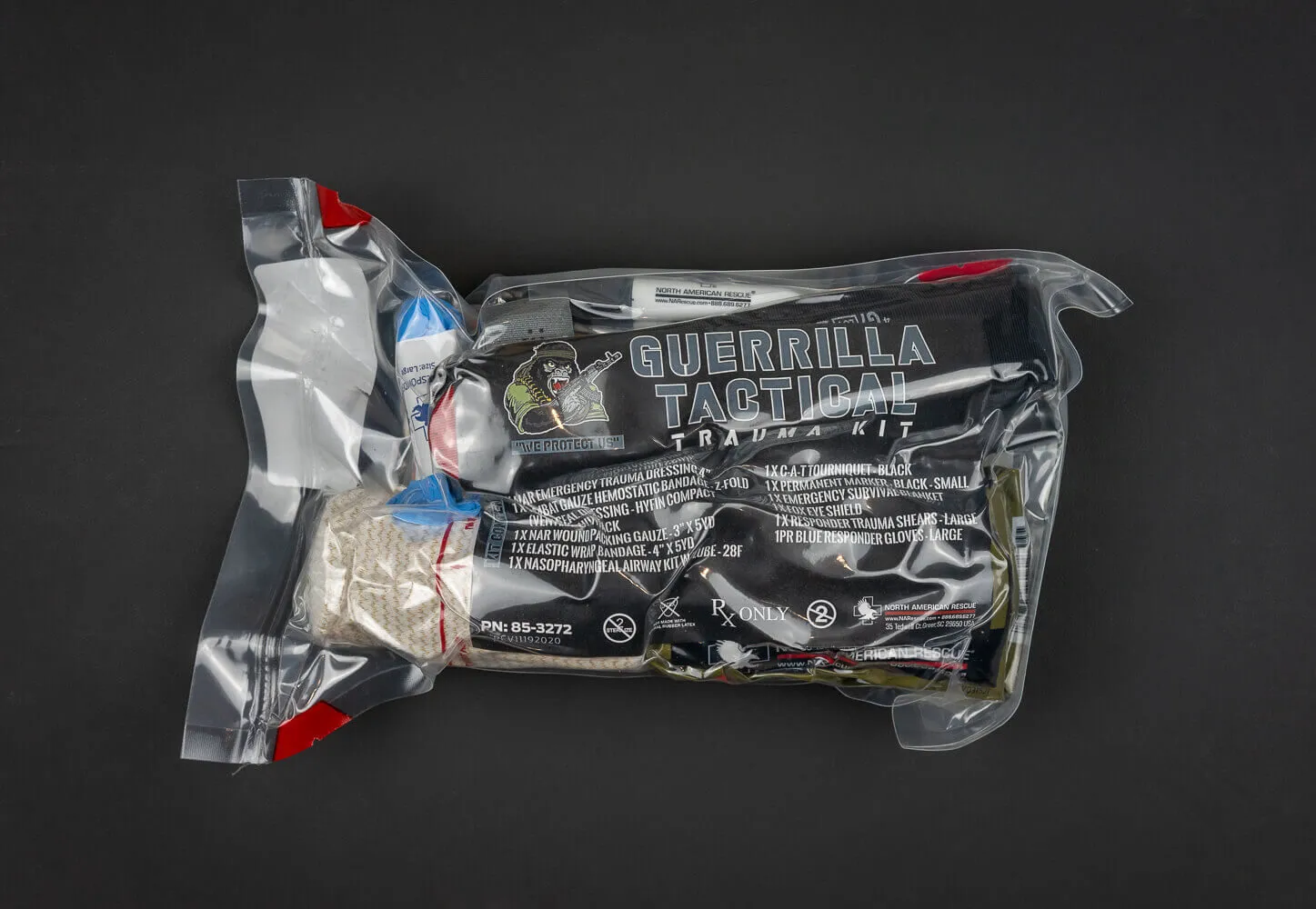
Traditional first aid kits require bulky plastic tackle boxes or rigid cases. At Guerrilla Tactical, we approach medical readiness differently. Our primary trauma kits, like the flagship Guerrilla Tactical Trauma Kit, are heavy-duty vacuum-sealed units. By removing the dead air space and eliminating fragile plastic boxes, we optimize the internal layout to squeeze maximum life-saving capability into an ultra-low-profile, weatherproof footprint.
This streamlined form factor gives you total modular flexibility. Because our kits aren’t locked into a single rigid box, they are engineered to integrate seamlessly into your existing daily life. You can drop a primary kit directly into your daily commuter backpack, slide it into a vehicle seat-back organizer, or pair it with rugged, dedicated mounting platforms, such as the K.I.S. Med Pack V2, for rapid-access belt mounting. It’s an adaptable trauma ecosystem that conforms to your lifestyle, not the other way around.

3. Scaled Options for Community Readiness
We don’t do one-size-fits-all solutions. Different environments demand different levels of preparation. That is why we offer a diverse ecosystem of scalable medical gear, precision-machined and assembled with 100% US-sourced materials straight out of our shop in Stevenson, Washington.
The Guerrilla Tactical Medical Ecosystem
- The Flagship Trauma Loadout: Our standard Guerrilla Tactical Trauma Kit (GTTK) line features premium, battle-tested hardware built to endure the harshest Pacific Northwest elements while keeping a full suite of MARCH-compliant tools flawlessly organized.
- The Secondary Stash & Refill: The GTTK Sidekick is a compact component cluster engineered to serve as a secondary stash of medical supplies in conjunction with your full-sized IFAK, or as a refill kit for your primary GTTK.
- Everyday Incident Management: For minor domestic realities, stacking your trauma gear alongside our Over-The-Counter Minor Incident & Thermal Injury Bundle ensures you have the proper remedies for burns, blisters, and secondary field care without dipping into or contaminating your primary trauma assets.
4. Maximizing IFAK Effectiveness Through Education
Buying pinnacle-tier hardware is only half the equation. True safety comes from an educated, highly competent mindset. You can buy excellent gear, but you cannot buy competence; you have to forge it.
Familiarizing yourself with your IFAK’s internal layout allows you to act confidently and effectively when dynamic human factors and massive stress try to slow you down. We highly recommend reviewing technical tactical training guides, such as the SOM In Extremis Guide, and seeking out hands-on, local stop-the-bleed classes. Know exactly where your tourniquet is, stage it properly for one-handed application, and practice wound packing until it’s muscle memory.

5. Maintenance and Restocking Best Practices
An IFAK isn’t a “set it and forget it” item. It is a life-saving system that requires regular operational checkups. To keep your medical readiness at 100%, implement a strict inspection schedule at least every six months:
- Check Expiration Dates: Scan your chest seals, compressed gauze, and hemostatic agents. Make sure the sterile packaging is still completely intact and well within its operational lifespan.
- Inspect Structural Integrity: Check the kit material, heavy-duty zippers, and mounting clips for any wear and tear from daily carry or prolonged exposure to harsh weather elements.
- Verify Tourniquet Staging: Ensure your tourniquet isn’t trapped inside annoying factory plastic wrap or buried under other supplies. It must be staged for immediate, zero-hindrance deployment.
- Restock Immediately: If you deploy any part of your kit during a real-world incident, replace it immediately to avoid catastrophic lapses in readiness.
Live Free. Be Safe. Stay Dangerous.
Ditching a bulky legacy first aid kit for a modern, trauma-informed IFAK is an immediate investment in the safety of yourself, your family, and your community. By prioritizing high-quality, American-made engineering and structured tactical protocols, you transform from a passive bystander into an incredibly capable asset on someone’s worst day.
Don’t wait for a crisis to realize your gear isn’t up to the task. Explore our full line of rugged, in-house engineered medical trauma solutions today. All orders ship out fast under our ironclad 1-3 business day “Quick Ship” pledge.
We don’t just assemble gear; we engineer it from the ground up in Stevenson, Washington, because we know that when a “bad day” arrives, your life depends on tight build tolerances and absolute reliability. We build this hardware to survive the harshest elements, ensuring that your equipment is never the weak link in a crisis. Invest in your readiness, watch out for one another, and stay dangerous.

Frequently Asked Questions (FAQ)
What is the difference between an IFAK and a traditional first aid kit?
A traditional first aid kit is designed to treat minor injuries like small cuts, scrapes, and minor burns with items like adhesive bandages and tweezers. An Individual First Aid Kit (IFAK) is structured specifically to treat life-threatening trauma and massive hemorrhaging using components like tourniquets, chest seals, and hemostatic gauze organized according to medical emergency protocols like MARCH.
What items should always be included in a tactical trauma kit?
A complete, reliable trauma kit must include core life-saving components to treat massive bleeding and airway injuries. This includes a high-quality windlass tourniquet (such as a C-A-T), a vented chest seal twin pack, wound-packing hemostatic gauze, an emergency trauma dressing, and heavy-duty trauma shears.
How often should I check and restock my IFAK?
You should conduct a thorough inspection of your IFAK at least once every six months. During this check, verify that all vacuum seals are intact, check the expiration dates on medical components like chest seals and gauze, ensure your tourniquet is properly staged for rapid use, and immediately replace any deployed or compromised items.
What is the function of the GTTK Sidekick?
The GTTK Sidekick is a streamlined, compact component array designed to act as either a secondary stash of core medical supplies or an immediate refill pack for your primary full-sized trauma kit. It is designed to slide easily into range bags, backpack pockets, or cummerbund side pouches.
Can bystanders effectively use an IFAK without military training?
Yes. Modern trauma gear is optimized for speed and simplicity under extreme stress. While specialized hands-on training (such as Stop the Bleed courses) is highly recommended to maximize confidence and muscle memory, structured medical layouts like the MARCH protocol are explicitly designed to help everyday citizens act as successful primary responders during domestic emergencies.
Conclusion: Preparedness Starts Before the Emergency
The difference between a positive outcome and a preventable tragedy often comes down to the equipment and knowledge available in the first few critical minutes of an emergency. While traditional first aid kits still have a place for treating minor injuries, they simply are not designed to address life-threatening trauma. A purpose-built IFAK gives you the tools needed to respond effectively to severe bleeding, airway emergencies, chest injuries, and other critical situations before professional medical help arrives.
Be sure to check out Guerrilla Tactical on Instagram and Youtube!